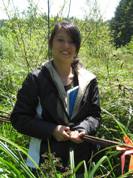
Sada Huynh
Chemeketa Community College
Project: Interpreting the science conducted at the South Slough National Estuarine Research Reserve
Summary: During the COSEE internship I had the opportunity to work with researchers, biologists, educators, and many other people. My project was interpreting the research projects that are conducted in South Slough, so it required me to work with others and learn about the different projects that are going on in the area. I wrote a newsletter about each of the projects I worked with, made PowerPoint presentations for some, and also made an educational toolkit for one. I learned about most of the projects by helping the researchers do field work and collect data. These projects included the Anderson Creek Restoration Project, the Non-native Snail Monitoring Project, the Secretive Marsh Bird Monitoring Project, and the SeagrassNet Monitoring Project. I also got to go in the field to help with the other COSEE interns’ projects on macroalgae and eelgrass interactions and on native oyster restoration in Coos Bay.
The project I got to spent most of my time with and develop the educational toolkit for was the Olympia Oyster Restoration Project with Steve Rumrill. I got to help clean oyster bags at the site, brush clean the oyster bags in the lab and measure the juveniles, measure and record the dead Olympia shells, and help the South Slough staff when 300 bags of Olympia baby oysters came down from the hatchery in Netarts Bay. The educational toolkit is like a folder with different types of materials, including PowerPoints, posters, video clips, and photographs, that can help the South Slough staff, volunteers, and visitors learn about the oyster research project. Having my work turn out nicely and to be helpful to South Slough’s interpretive center meant a lot to me.
My Experience: After learning about the different projects in South Slough, you kind of see a connection between each project. For example, water quality and climate change will connect with the eelgrass monitoring. Marine science is so important; the world revolves around the marine ecosystem. I never realized how marine science is needed and how everyday things depend on and affect the marine world.
From the COSEE internship, I learned more about myself and about marine biology and the marine environment. The best part is that this internship helped me to open doors to different careers, which I am grateful for because I am having a difficult time deciding on what career I want to pursue. I think the PRIME program helped me a lot. I’m glad that a program like this is offered to community college students because not only university students are looking for these types of experiences; community college students are searching for them too. I would encourage community college students to apply to the PRIME program because it is a fun learning and working experience that will always be remembered.
Mentor: Tom Gaskill, Education Programs Coordinator, South Slough National Estuarine Research Reserve